
Moroccan Argan Oil: The Complete Guide to Liquid Gold
Moroccan argan oil, often called the liquid gold of Morocco, has evolved from a Berber beauty secret into a $300+ million global industry — and Morocco remains its only authentic source. Extracted from the kernels of the argan tree (Argania spinosa), which grows exclusively across roughly 8,000 km² of the Souss-Massa region in southwestern Morocco, this amber oil has been used for centuries by local women for cooking, skincare, and hair care. UNESCO recognised the Arganeraie as a Biosphere Reserve in 1998, and global demand has since pushed the market to approximately $280 million in 2024, with projections of 8–10% annual growth through 2030.This guide explains exactly what Moroccan argan oil is, how it’s produced, what the science says about its benefits, and how to buy a genuinely authentic product.
Key Takeaways
- Moroccan argan oil is produced exclusively from the kernels of the argan tree (Argania spinosa), which grows only in southwestern Morocco — no other country produces authentic argan oil.
- Cold-pressed, culinary-grade argan oil retains up to 80% unsaturated fatty acids and roughly double the vitamin E content of olive oil (62 mg per 100 g vs. 26 mg per 100 g).
- The argan oil market is projected to exceed $400 million by 2030, driven by rising demand in cosmetics, skincare, and culinary sectors.
- Authentic Moroccan argan oil costs between $30 and $50 per 100 ml — significantly cheaper products are almost certainly diluted or synthetic.
- Both culinary and cosmetic grades exist; they are extracted differently and should never be used interchangeably.
The Complete Answer: What Is Moroccan Argan Oil?
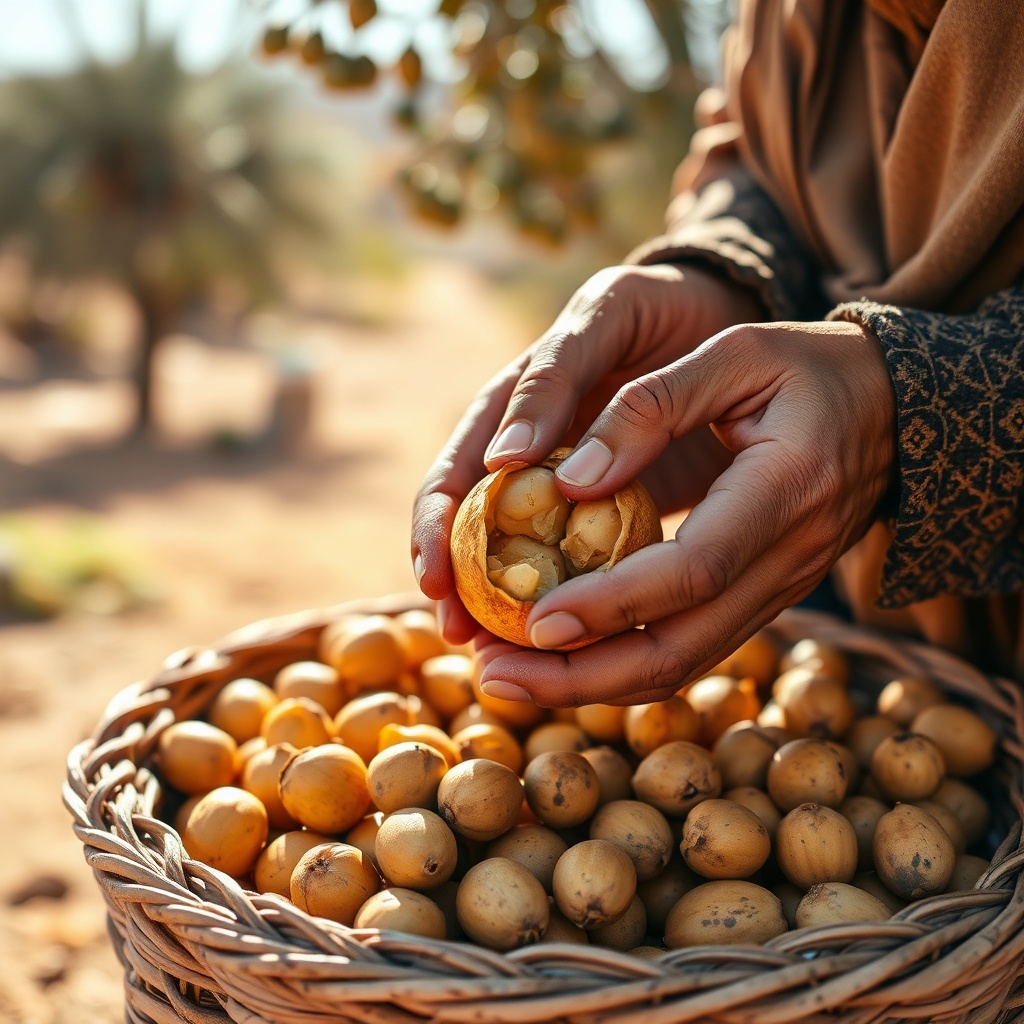
A cultural and hands-on view of the initial step in making Moroccan argan oil.
Moroccan argan oil is a cold-pressed plant oil derived from the kernels inside the fruit of the argan tree, and its chemical profile explains why it commands premium prices worldwide. The oil consists of roughly 45% oleic acid, 35% linoleic acid, 12% palmitic acid, and 6% stearic acid — totalling about 80% unsaturated fatty acids. It also delivers 62 mg of tocopherol (vitamin E) per 100 g, nearly 2.5 times the amount found in olive oil, plus rare plant sterols called schottenol and spinasterol that appear in very few other edible oils. These compounds together give argan oil its anti-inflammatory, antioxidant, and skin-regenerating properties.
Quick Answer: Moroccan argan oil is a cold-pressed oil from argan tree kernels, containing ~80% unsaturated fatty acids and 62 mg of vitamin E per 100 g — nearly 2.5× more than olive oil. It comes in two grades: culinary (roasted kernels, nutty flavour) and cosmetic (raw kernels, lighter scent). Only southwestern Morocco produces authentic argan oil.
What Makes Moroccan Argan Oil Unique?
Geographic exclusivity is the core of argan oil’s value. The argan tree cannot be commercially cultivated outside its native range — attempts in California, Israel, and Australia have failed to produce viable harvests. The tree’s roots plunge more than 30 metres deep, allowing it to survive in semi-desert conditions while anchoring topsoil and preventing desertification across the Souss-Massa plain. This ecological role is why UNESCO designated the Arganeraie a Biosphere Reserve in 1998, protecting both the trees and the traditional harvesting practices that sustain them.
Definition: Argania spinosa — the scientific name of the argan tree, an endemic species that grows wild only in southwestern Morocco and produces the fruit whose kernels yield argan oil.
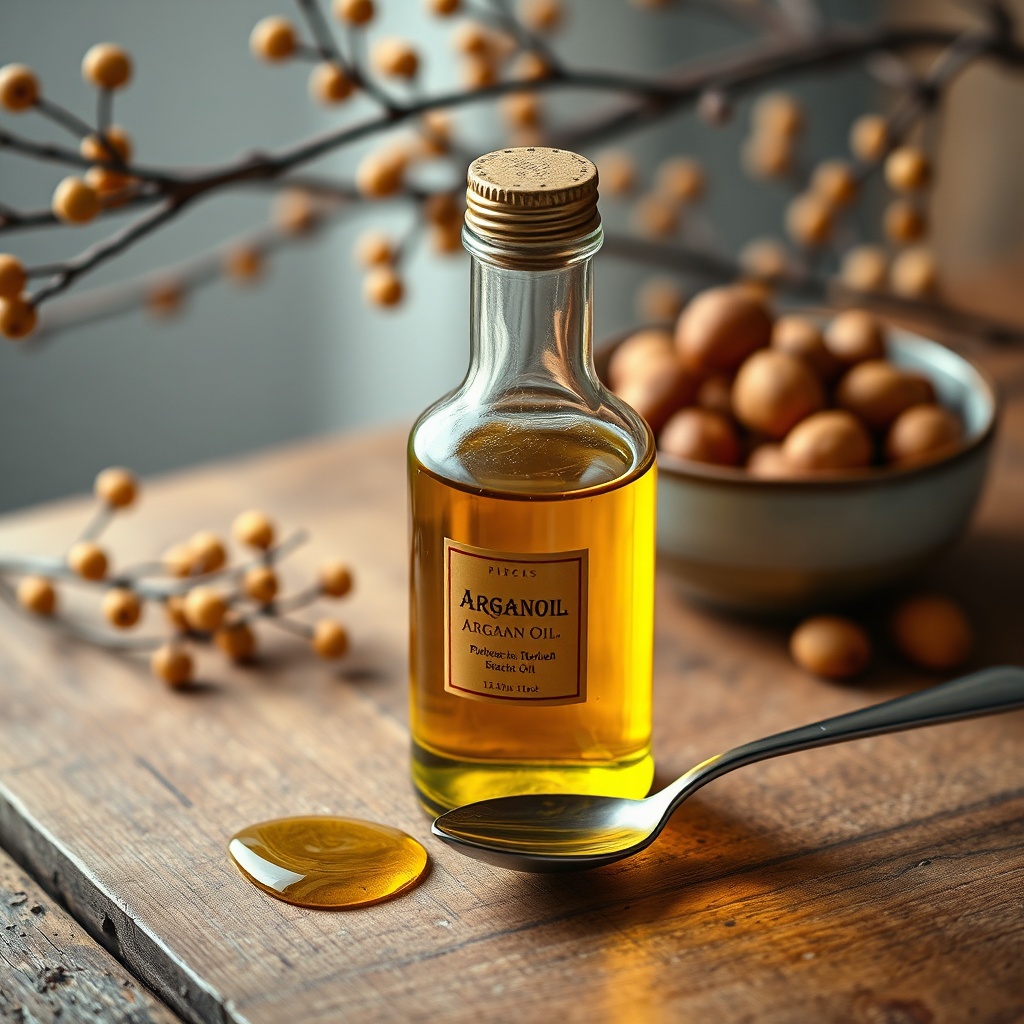
A polished product shot showcasing the color and versatility of Moroccan argan oil.
Culinary vs. Cosmetic Grade: Key Differences
The two commercial grades of Moroccan argan oil differ in production and use. Culinary-grade oil comes from kernels that are gently roasted before pressing, which develops a deep amber colour and a toasted, nutty flavour ideal for drizzling over salads or couscous. Cosmetic-grade oil is pressed from raw, unroasted kernels, preserving delicate antioxidants but producing a lighter scent and pale golden-yellow colour. Cosmetic-grade oil should never be heated or consumed — it’s formulated for topical application only.
The Extraction Process: From Fruit to Liquid Gold
Producing authentic Moroccan argan oil is extraordinarily labour-intensive, which explains its premium price tag. One litre of oil requires 30–40 kg of argan fruit and 10–12 hours of manual labour, and Morocco produces roughly 4,000–5,000 tonnes annually. Over 90% of extraction now happens through women’s cooperatives, with more than 2.5 million women involved, and a growing share uses mechanical cold-pressing at temperatures below 50°C to preserve nutrients.
Quick Answer: One litre of authentic argan oil requires 30–40 kg of fruit and 10–12 hours of manual labour. Morocco produces 4,000–5,000 tonnes per year, with over 90% of extraction handled by women’s cooperatives using cold-pressing below 50°C to preserve nutrients. This labour intensity is why genuine oil commands premium prices.
Step-by-Step: How Argan Oil Is Made
- Harvesting: Ripe argan fruits fall between June and August and are collected by hand or with nets spread beneath the trees.
- Drying: Fruits are sun-dried on rooftops for 2–4 weeks until the pulp shrivels and loosens.
- De-pulping: The dried outer flesh is removed by hand, revealing the hard nut inside.
- Cracking: Each nut is cracked open with two stones to extract 1–3 kernels — the most labour-intensive step in the entire process.
- Roasting (culinary only): Kernels are gently roasted over low heat to develop the nutty flavour; cosmetic-grade oil skips this step entirely.
- Cold-pressing: Kernels are mechanically pressed below 50°C, then filtered and bottled in amber glass to protect against light degradation.
The Rise of Women’s Cooperatives
Women’s cooperatives have transformed the argan oil economy. Networks like the Targanine cooperative and the Union of Women’s Cooperatives of the Souss-Massa region now employ thousands of rural women who previously had no independent income. Many of these cooperatives hold Fair Trade certification (Fair for Life) and export directly to Europe and North America. UNESCO further recognised argan-related practices as Intangible Cultural Heritage in 2014, cementing the oil’s status as a cultural as well as economic asset.
Proven Health and Beauty Benefits: What the Science Says
Clinical evidence supports many of argan oil’s traditional uses. A 2015 study in the Journal of Cosmetic Dermatology found that daily topical application for 60 days significantly improved skin elasticity and hydration in postmenopausal women. A 2017 study reported that argan oil reduced sebum production by up to 30% in acne-prone skin while improving the skin barrier. Its high linoleic acid content (35%) helps reduce transepidermal water loss, a key driver of dry skin. For hair, a 2021 comparative trial showed a 40% reduction in split ends over 8 weeks with 3× weekly application.
Quick Answer: Clinical studies show argan oil improves skin elasticity and hydration within 60 days of daily use, reduces sebum by up to 30% in acne-prone skin, and cuts split ends by 40% over 8 weeks. Its linoleic acid content reduces moisture loss, while vitamin E neutralises free radicals that accelerate ageing.
Skin Benefits: Hydration, Elasticity, and Anti-Ageing
Argan oil works on skin through three mechanisms. Linoleic acid strengthens the lipid barrier, reducing water loss and flakiness. Vitamin E neutralises free radicals that accelerate ageing. The rare sterols schottenol and spinasterol stimulate collagen production, improving firmness over time. Because it’s rated 2 on the comedogenic scale, it hydrates without clogging pores — making it suitable even for acne-prone and sensitive skin types.
Hair Benefits: Repair, Shine, and Scalp Health
Argan oil’s lightweight molecular structure lets it penetrate the hair shaft rather than coating it, delivering moisture and shine without greasiness. It’s particularly effective against frizz in high-humidity conditions, where heavier oils like coconut can weigh hair down. Applied to mid-lengths and ends 3× weekly, it reduces breakage and split ends while soothing a dry, itchy scalp.
Internal Health: Culinary Argan Oil and Cardiovascular Markers
A 2018 Moroccan study on hypercholesterolemic subjects found that consuming 25 ml of culinary argan oil daily for 3 weeks reduced LDL (“bad”) cholesterol by 14% and increased HDL (“good”) cholesterol by 20%. The effect is attributed to the oil’s high oleic acid content and plant sterols, which interfere with cholesterol absorption in the gut. Culinary argan oil can therefore be a heart-healthy addition to a Mediterranean-style diet.
Moroccan Argan Oil vs. Other Carrier Oils: An Honest Comparison
Comparing argan oil with coconut, jojoba, and rosehip oils reveals where the premium price is justified — and where it isn’t. The table below summarises the key differences.
Quick Answer: Argan oil beats coconut oil on vitamin E (62 vs 0.1 mg/100 g), has a lower comedogenic rating than coconut (2 vs 4), and offers dual culinary/cosmetic use. It loses on price ($30–50 vs $3–8 per 100 ml) and shelf life (18–24 vs 24+ months). For face, hair, and cooking from one bottle, it’s the more versatile choice.
| Property | Moroccan Argan Oil | Coconut Oil | Jojoba Oil | Rosehip Oil |
|---|---|---|---|---|
| Comedogenic rating (0–5) | 2 (low) | 4 (high — can clog pores) | 2 (low) | 1 (very low) |
| Vitamin E (mg/100 g) | 62 | 0.1 | 2 | 60 |
| Oleic acid content | ~45% | ~6% | ~10% | ~15% |
| Absorption speed | Fast | Slow | Fast | Very fast |
| Shelf life (unopened) | 18–24 months | 24+ months | 12–18 months | 12 months |
| Best for | Face, hair, cooking | Hair, body, cooking | Face, scalp | Face, scar treatment |
| Average price per 100 ml | $30–50 | $3–8 | $15–25 | $20–35 |
Where Argan Oil Wins
Argan oil’s vitamin E content is 620 times higher than coconut oil’s and comparable to rosehip’s, but its non-comedogenic profile and dual culinary/cosmetic use give it a versatility neither coconut nor rosehip can match. Its rarity — every bottle comes from a single geographic region — adds a provenance story that resonates with premium skincare buyers.
Where Argan Oil Loses
The honest downsides: argan oil costs 4–10× more than coconut oil, it spoils faster once opened (6–12 months vs coconut’s longer window), and authentic product is genuinely hard to find outside Morocco. If your budget is tight and you need a single-purpose oil for body moisturising, coconut oil is the pragmatic choice. For face, hair, and cooking from one bottle, argan oil justifies its price.
How to Choose Authentic Moroccan Argan Oil: 7 Red Flags to Avoid
Industry reports estimate that up to 70% of argan oil sold globally is adulterated or synthetic — often diluted with sunflower or olive oil. Authentic cold-pressed argan oil has a nutty, slightly earthy aroma, not a strong cosmetic perfume scent. Price is a reliable first filter: below $15 per 100 ml, authenticity is highly unlikely.
Quick Answer: Up to 70% of argan oil sold globally is estimated to be adulterated or synthetic. Authentic oil costs $30–50 per 100 ml, lists only “Argania Spinosa Kernel Oil” as an ingredient, carries ECOCERT or USDA Organic certification, comes in amber glass, and smells nutty — not floral.
Red Flag Checklist
- Price: Below $15 per 100 ml = almost certainly diluted.
- Ingredient list: Should contain only “Argania Spinosa Kernel Oil” — nothing else.
- Colour: Cosmetic grade is pale golden-yellow; culinary grade is deeper amber. Unnaturally bright or clear oil suggests refining or blending.
- Certification: Look for ECOCERT, USDA Organic, or Fair Trade (Fair for Life) labels.
- Packaging: Dark amber glass bottles protect against light degradation; clear plastic is a red flag.
- Origin: Must state “Product of Morocco” — not “packaged in” another country.
- Scent: True argan oil smells nutty, not floral or “perfumed.”
How to Test Authenticity at Home
The fridge test is a reliable home check. Place a small amount of oil in a glass jar and refrigerate for 2 hours. Pure argan oil stays liquid and clear at refrigerator temperatures, whereas oils like coconut or palm will cloud or harden. If your “argan oil” solidifies, it’s been cut with a cheaper saturated fat.
How to Use Moroccan Argan Oil: A Practical Application Guide
Getting the most from Moroccan argan oil comes down to dosage, timing, and technique. The routines below are based on how the oil is used in Moroccan households and what clinical studies have tested.
Quick Answer: For face, warm 2–3 drops between palms and press into damp skin twice daily. For hair, apply 3–5 drops to mid-lengths and ends 3× weekly. For body, use 5–10 drops post-shower. Always finish facial application with SPF 30+ — argan oil is not a sunscreen.
Step-by-Step: Morning Facial Routine with Argan Oil
- Cleanse your face with a gentle, non-stripping cleanser and pat dry — leave skin slightly damp.
- Warm 2–3 drops of argan oil between your palms for 5 seconds to activate absorption.
- Press the oil into your face and neck using upward, outward motions — don’t rub aggressively.
- Wait 60 seconds for absorption, then apply moisturiser on top to seal in the oil.
- Finish with SPF 30+ — argan oil works synergistically with sunscreen, not as a replacement.
Hair Application: The Overnight Mask Method
For a weekly deep treatment, apply 5–8 drops to mid-lengths and ends, wrap your hair in a warm towel, and leave it overnight. Shampoo in the morning. If you have an oily scalp, keep argan oil away from the roots — it’s designed for the hair shaft, not the scalp.
Dosage and Frequency Guidelines
| Use | Dosage | Frequency |
|---|---|---|
| Face | 2–3 drops | 2× daily |
| Hair ends | 3–5 drops | 3× weekly |
| Body | 5–10 drops | Daily post-shower |
| Cuticles/nails | 1 drop per nail | Daily |
FAQ: Moroccan Argan Oil
Is Moroccan argan oil good for your face?
Yes — argan oil is non-comedogenic (rated 2/5), rich in vitamin E and linoleic acid, and clinically shown to improve skin elasticity and hydration within 60 days of daily use. It suits most skin types, including sensitive and acne-prone skin.
How often should you use argan oil?
For facial use, apply 2–3 drops twice daily (morning and night). For hair, use 3–5 drops on mid-lengths and ends 3 times per week. For body, apply daily after showering while skin is still damp.
Can argan oil help with hair growth?
Argan oil does not directly stimulate hair follicles, but it improves scalp health, reduces inflammation, and prevents breakage — which reduces hair loss and supports healthier, longer hair over time. A 2021 trial showed a 40% reduction in split ends over 8 weeks.
How can you tell if authentic Moroccan argan oil is real?
Check for a single ingredient (“Argania Spinosa Kernel Oil”), “Product of Morocco” labelling, ECOCERT or USDA Organic certification, a nutty (not floral) scent, amber glass packaging, and a price above $15 per 100 ml.
Does argan oil expire?
Yes. Unopened, cold-pressed argan oil lasts 18–24 months. Once opened, it should be used within 6–12 months. Signs of rancidity include a sharp, bitter odour and a sticky texture.
Conclusion
Moroccan argan oil’s geographic exclusivity, its scientifically validated benefits, and its dual culinary and cosmetic roles make it one of the most versatile plant oils available. The concentrated vitamin E (62 mg per 100 g) and rare sterols justify the $30–50 per 100 ml price tag for anyone seeking a multi-purpose skincare and cooking staple. Whether you’re new to plant oils or a seasoned skincare enthusiast, few oils pack this much nutritional and cosmetic value into a single bottle. Before you buy, verify the origin, check for ECOCERT or USDA Organic certification, and run the fridge test at home. Start with a small 30 ml bottle to test how your skin and hair respond before committing to a larger purchase — and buy directly from certified Moroccan cooperatives whenever possible to ensure you’re getting the real thing.