
Marrakesh airport transfer vs car rental — the choice shapes your entire trip before you even land.Marrakesh Menara Airport (RAK) sits just 6 km from the city centre, yet the decision between a pre-booked transfer and a rental car determines your cost, stress level, and whether you can physically reach your accommodation. For most visitors, the answer is clear: book an airport transfer unless your itinerary includes at least three days of driving outside the city. This guide compares both options across cost, convenience, safety, and practical reality — using current 2026 pricing, local traffic data, and insider knowledge of Marrakesh’s unique driving conditions. Whether you are a first-time visitor heading to a medina riad or a seasoned traveller planning desert road trips, the breakdown below gives you the definitive answer.
Key Takeaways
- Airport transfers cost roughly €15–€25 one-way and eliminate all driving stress, while car rentals start at €15–€35 per day but add parking, fuel, and insurance costs that can double the total.
- Over 70% of Marrakesh’s most popular riads sit inside the medina’s pedestrian-only zones, making car access physically impossible for many accommodations.
- Driving in Marrakesh carries specific risks: an accident rate roughly 3× higher than the European average, aggressive roundabout etiquette, and frequent police checkpoints targeting rental vehicles.
- A car rental only becomes financially logical if you plan 3+ days of out-of-city driving (e.g., Essaouira, Atlas Mountains, or Sahara trips).
- The hybrid approach — transfer on arrival, rent a car later from a city-centre agency — delivers the best of both options for most travellers.
The Complete Answer: Marrakesh Airport Transfer vs Car Rental — Which Should You Choose?

A traveler experiences the ease of a pre-booked airport transfer, contrasting with the stress of self-driving.
For the majority of Marrakesh visitors, an airport transfer is the correct choice. The definitive answer: book a pre-arranged transfer unless your itinerary includes at least three days of driving outside the city. This conclusion rests on five measurable factors: accommodation accessibility, cost per day, driving stress, parking availability, and insurance complexity.
Why Transfers Win for Most Travellers
Approximately 80% of tourists staying in the medina find that their riad is unreachable by car. The old city’s narrow, winding streets are pedestrianised, and luggage must often be carried by hand through alleyways. A transfer driver knows exactly where to stop and which porters to call. Pre-booked private airport transfers through operators like Marrakech Airport Transfers or Suntransfers include meet-and-greet service inside the arrivals hall, flight tracking, and fixed pricing with no surge fees.
Quick Answer: Book an airport transfer unless you plan three or more days of out-of-city driving. Transfers cost €15–€25 one-way, include meet-and-greet service, and solve the medina’s parking problem entirely. Car rental only wins for multi-day road trips, groups of 4+, or travellers staying in modern hotels with free parking.
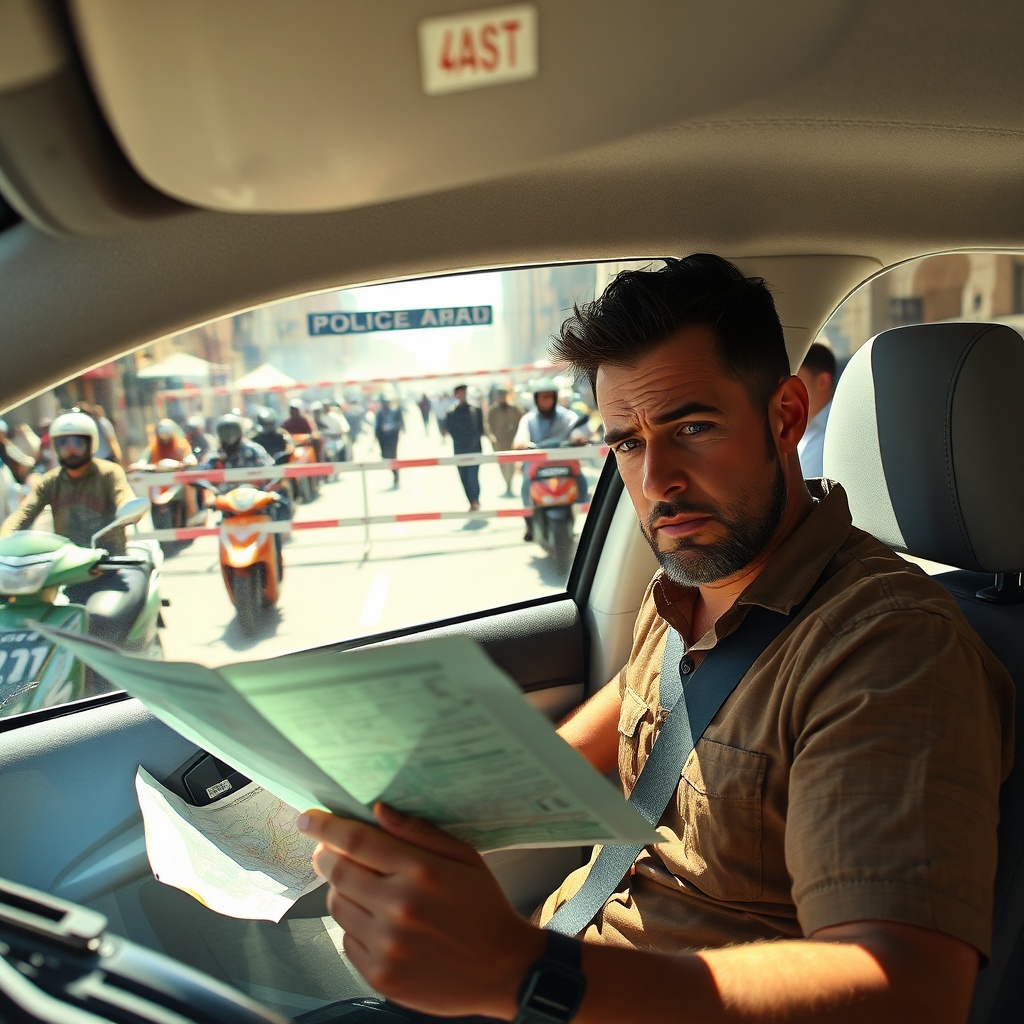
A rental car driver faces the chaotic streets of Marrakesh, emphasizing the advantages of an airport transfer.
When Car Rental Becomes the Smart Play
The calculus changes if you are staying in a modern hotel in Gueliz (the new city), Hivernage, or Palmeraie — all of which offer free or cheap parking. A rental car also makes sense for travellers combining Marrakesh with a multi-day desert tour or coastal road trip to Essaouira (2.5 hours away). For these itineraries, the daily rental cost amortises across hundreds of kilometres where taxis and transfers would cost far more.
Definition: CDW (Collision Damage Waiver) — an optional insurance product that reduces your financial liability if the rental car is damaged. In Morocco, standard rental contracts carry an excess (deductible) of 8,000–15,000 MAD (€720–€1,350), which CDW reduces but rarely eliminates.
Cost Breakdown: The Real Numbers Behind Each Option
Raw prices tell only half the story. A 2026 comparison of car rental companies in Marrakech — Hertz, Avis, Sixt, and local operators like Locar and Medloc — shows base rates of €15–€35 per day for a compact car like a Dacia Logan. However, mandatory third-party insurance, CDW, and airport surcharges add €10–€20 daily. Full coverage with zero excess typically pushes the total to €35–€55 per day.
Airport transfers, by contrast, are all-inclusive. A private sedan transfer from RAK to the medina costs €15–€20; a larger van for groups costs €25–€35. Official airport taxis (the petite taxis) charge a fixed 100–150 MAD (€9–€14) to city destinations, though night surcharges apply after 8 PM.
Quick Answer: A 3-day car rental in Marrakesh costs roughly €175 all-in, versus €35 for return airport transfers. The difference comes from insurance (€30), parking (€45), fuel (€25), and airport surcharges (€15). Transfers are all-inclusive; rentals carry hidden costs that double the advertised daily rate.
The Hidden Costs of Car Rental
- Fuel: petrol costs approximately 15.5 MAD/litre (€1.40) in 2026; a round trip to Essaouira consumes roughly €20 in fuel.
- Parking: street parking in Gueliz costs 20–40 MAD/day, while secure hotel parking runs 50–100 MAD/night.
- Tolls: the A3 motorway to Casablanca charges 60 MAD one-way.
- Fines: speed cameras are widespread; a typical speeding fine is 300–700 MAD.
Price Comparison Table: 3-Day Scenario
| Cost Item | Airport Transfer (return) | Car Rental (3 days) | |—|—|—| | Base transport | €35 (two one-way transfers) | €60 (€20/day compact) | | Insurance/CDW | Included | €30 (€10/day full cover) | | Parking | €0 | €45 (3 nights hotel parking) | | Fuel | €0 | €25 (city + one day trip) | | Airport surcharge | €0 | €15 | | Total | €35 | €175 | | Per day | €11.67 | €58.33 |
Time and Convenience: Which Option Gets You Faster to Your Riad?
The time difference between transfers and car rental is stark. With a pre-booked transfer, you walk from arrivals baggage claim to a waiting driver in under 5 minutes. The drive from RAK to the medina’s edge takes 15–25 minutes, depending on traffic. Total time from touchdown to riad doorstep: approximately 45–60 minutes.
Renting a car adds significant friction. After clearing arrivals, you must take a shuttle to the off-airport rental desks (most agencies, including Hertz and Avis, are located 500m from the terminal). The paperwork, vehicle inspection, and insurance negotiation typically consume 30–45 minutes. Then you face the RAK exit roundabout — notorious for aggressive merging — before navigating Marrakesh’s congested ring road. Total time: 1.5–2 hours minimum.
Quick Answer: A pre-booked transfer gets you from touchdown to your riad in 45–60 minutes. Renting a car adds 30–45 minutes of paperwork plus shuttle time, pushing the total to 1.5–2 hours. For late arrivals, that difference can mean missing your riad’s check-in window entirely.
The Check-In Time Advantage
Most riads require check-in before 8 PM and close their street doors by midnight. A transfer’s predictability protects your arrival window. Rental car delays — a slow queue, a disputed damage claim, or a wrong turn into the medina’s one-way system — can push you past your riad’s check-in cutoff, leaving you stranded with luggage at midnight.
Navigation and GPS Reality
Google Maps works reasonably well in Marrakesh, but the medina’s pedestrian zones appear as drivable roads on many mapping apps. Rental cars frequently end up trapped in alleyways too narrow to reverse out of. Transfer drivers, by contrast, use established drop-off points and coordinate with riad staff for porter assistance.
The Hidden Risks: Driving in Marrakesh as a Tourist
Driving in Marrakesh is not like driving in Europe or North America. Morocco’s road fatality rate stands at roughly 18 deaths per 100,000 inhabitants — approximately 3× the EU average. Within the city, lane markings are treated as suggestions, scooters weave between cars, and roundabouts operate on a “priority to the bold” system rather than legal right-of-way rules.
Quick Answer: Driving in Marrakesh carries real risks: an accident rate roughly 3× the EU average, aggressive roundabout behaviour, and frequent police checkpoints. You must carry your passport, international driving permit, rental contract, and insurance certificate at all times. Missing documents trigger fines of 300–500 MAD.
The Police Checkpoint Reality
Moroccan police operate frequent checkpoints (contrôles routiers) across Marrakesh, particularly on Avenue Mohammed VI and the airport road. Rental cars are disproportionately flagged because officers know tourists are unfamiliar with local documentation requirements. You must carry your passport, international driving permit (IDP), rental contract, and insurance certificate at all times. Missing any document results in on-the-spot fines of 300–500 MAD (€27–€45).
Definition: IDP (International Driving Permit) — a document that translates your national driving licence into multiple languages. Moroccan law requires an IDP alongside your home licence for all foreign drivers, and police checkpoints routinely ask for both.
Insurance Fine Print That Costs Travellers
Standard rental agreements in Morocco include a hefty excess (deductible) of 8,000–15,000 MAD (€720–€1,350). Minor scratches — common in tight medina parking — trigger the full excess unless you purchased zero-excess coverage. A 2025 survey by Morocco Travel Forum found that 34% of car renters reported damage disputes at drop-off, with an average disputed amount of €180.
The Medina Driving Ban
Since 2023, Marrakesh has enforced stricter vehicle restrictions inside the medina walls. Non-resident vehicles are prohibited between 6 AM and 11 PM on major medina thoroughfares. Violations carry fines up to 1,000 MAD (€90). For tourists staying in the medina, a rental car becomes a liability rather than an asset.
When Car Rental Makes Sense: The Exceptions and Hybrid Strategy
Car rental becomes genuinely advantageous in three specific scenarios. First, travellers staying in Gueliz or Palmeraie hotels with free parking avoid the parking cost penalty entirely. Second, groups of 4–5 people split the rental cost, making it competitive with multiple transfer bookings. Third, and most importantly, itineraries involving 3+ days of out-of-city driving justify the rental overhead.
Quick Answer: Rent a car only if you stay in a hotel with free parking, travel as a group of 4+, or plan 3+ days of out-of-city driving. For everyone else, the hybrid strategy — transfer on arrival, rent later from a city-centre agency — delivers the best value and lowest stress.
The Optimal Hybrid Approach
The smartest strategy used by experienced travellers: book a one-way airport transfer on arrival (€15–€20), settle into your riad, and arrange a car rental from a city-centre agency in Gueliz for the specific days you plan to leave Marrakesh. Agencies like Locar and Medloc have branches walking distance from most hotels. This approach costs only slightly more than a full-week rental while eliminating airport pickup friction and medina parking problems for your first night.
Recommended Day-Trip Distances
- Essaouira: 185 km, 2.5 hours each way — viable day trip
- Atlas Mountains (Imlil): 65 km, 1.5 hours — popular half-day
- Ouarzazate: 200 km, 3.5 hours — requires overnight
- Sahara (Merzouga): 560 km, 9 hours — multi-day commitment
Step-by-Step: How to Choose Between Transfer and Car Rental
Follow this numbered decision process before booking:
- Identify your accommodation type. If staying in the medina (Riad Dar Zaman, Riad Yasmine, etc.), skip car rental entirely — transfers win automatically.
- Count your out-of-city driving days. If fewer than 3 days of planned road trips, book transfers for all airport movements.
- Calculate your group size. For 4+ travellers, compare the cost of two transfers (€40–€50) against a single rental day (€55+ with insurance) — transfers usually win for airport-only journeys.
- Check your hotel’s parking situation. Confirm free parking exists before considering rental; 100 MAD/night parking negates rental savings.
- Verify your driving credentials. Ensure you hold an International Driving Permit (IDP) — required by Moroccan law alongside your national licence.
- Book transfers at least 24 hours in advance. Same-day bookings cost 30–50% more and reduce driver availability during peak arrival hours (11 AM–3 PM).
- If renting, choose zero-excess insurance. Pay the extra €8–€12 per day to eliminate the 8,000–15,000 MAD deductible risk.
Quick Answer: Use this seven-step checklist: accommodation type first, then driving days, group size, parking, IDP, booking lead time, and insurance. The medina question alone decides 80% of cases — if you stay inside the old city walls, transfers win before you even compare prices.
Frequently Asked Questions
How much is a taxi from Marrakesh airport to the medina?
Official petite taxis charge a fixed rate of 100–150 MAD (€9–€14) for the 15–25 minute journey, with a 50% night surcharge between 8 PM and 6 AM. Pre-booked private transfers cost €15–€20 but include meet-and-greet service and guaranteed availability.
Is it safe to drive in Marrakesh as a tourist?
Driving is legal and manageable for confident drivers, but Morocco’s accident rate is roughly 3× the EU average. The main risks are aggressive roundabout behaviour, scooters appearing in blind spots, and police checkpoints requiring your passport, IDP, rental contract, and insurance documents.
Can I park a rental car inside the Marrakesh medina?
No. Non-resident vehicles are prohibited on major medina thoroughfares between 6 AM and 11 PM, and most alleyways are too narrow for cars. Use secure parking in Gueliz (50–100 MAD/night) or hotel parking instead.
Do I need an International Driving Permit to rent a car in Morocco?
Yes. Moroccan law requires an IDP alongside your national driving licence. Rental agencies may not ask, but police checkpoints will — and missing an IDP results in fines of 300–500 MAD (€27–€45).
What is the best way to get from Marrakesh airport to a riad in the medina?
A pre-booked airport transfer is the best option. Drivers know the correct drop-off points at the medina’s edge and can arrange porters to carry luggage through pedestrian alleyways. Taxis drop you at the medina gates, but you must manage luggage yourself from there.
Conclusion
The Marrakesh airport transfer vs car rental decision ultimately comes down to your itinerary’s shape. For city-focused trips — the vast majority of visits — airport transfers deliver lower cost, zero stress, and direct access to medina accommodations. Car rental only becomes the right call for travellers with 3+ days of out-of-city driving, group cost-sharing, or modern hotels with free parking. The hybrid strategy — transfer on arrival, rent later in the city — offers the flexibility many travellers overlook. Whichever option you choose, book ahead, carry your documents, and plan your arrival around Marrakesh’s traffic patterns. A well-planned arrival sets the tone for everything that follows in the Red City.